
10 Oct 23 - Activity: Matching Boundary Conditions and Plotting the Potential
Azimuthally Symmetric Solutions
As we saw, azimuthally symmetric solutions, the electric potential is independent of $\phi$ and the solutions are of the form:
$$V(r,\theta) = \sum_{n=0}^\infty \sum_{l=0}^\infty \left(A_{nl} r^n + \frac{B_{nl}}{r^{n+1}}\right) P_l(\cos\theta)$$
where $P_l(\cos\theta)$ are the Legendre polynomials. The coefficients $A_{nl}$ and $B_{nl}$ are determined by the boundary conditions. We will practice solving for these coefficients in this activity.
✅ Do this
Sphere of constant surface potential
Consider a sphere of with a radius $a$. If the potential on the surface is $V_0$, what is the potential inside and outside the sphere?
- Consider the radial solutions (what doesn't blow up?)
- Consider the polar angle solutions, what has to be true? What does that say about terms with $l>0$?
- Write down the solution inside and outside the sphere.
- Make a heat map plot (in $x$ and $y$) of the potential inside and outside the sphere. You can set $a=1$ and $V_0=1$ if that helps.
## your code here✅ Do this
Sphere of variable potential
Consider a sphere of with a radius $a$. If the potential on the surface is $V(\theta)$, what is the potential inside and outside the sphere?
- Consider the radial solutions (what doesn't blow up?)
- Consider the polar angle solutions, what has to be true? Can you say anything about them?
- What if $V(\theta) = V_0 \cos(\theta)$? What is the potential inside and outside the sphere?
A thick spherical shell
Suppose you have a spherical shell of inner radius $a$ and outer radius $b$, and you know the electric potential on the inner ($V(a,\theta) = V_a(\theta)$) and outer ($V(b,\theta) = V_b(\theta)$) surfaces. You want to find the electric potential $V(r,\theta)$ inside the hole ($r
Let's allow:
$$V_a(\theta) = V_{a0} + V_{a1} \cos(\theta)$$ $$V_b(\theta) = V_{b0} + V_{b1} \cos(\theta)$$
- What is the general solution? (all three regions)
- What are the boundary conditions for $r$?
- What terms are left in the general solutions?
- Find the unique solution for $V(r,\theta)$ inside the hole ($r
What do you do in the case of $V_a(\theta) = f(\theta)$ and $V_b(\theta) = g(\theta)$ - generic functions?
Example of Polarization
✅ Do this
Put a metal sphere of radius $a$ in a uniform electric field $\vec{E} = E_0 \hat{z}$.
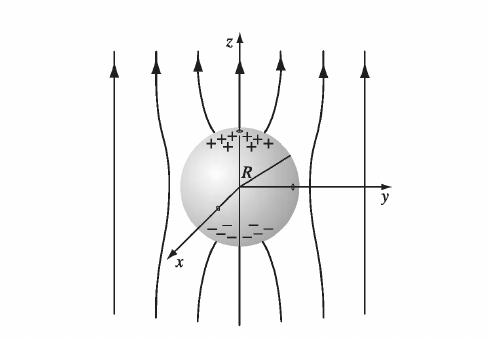
What is the potential inside and outside the sphere?
- Draw the picture and write down the boundary conditions. What is the potential everywhere on a metal?
- What general solution do you need to use? How do you know?
- What are the boundary conditions for the radial solutions? The polar angle solutions?
- Match your boundary conditions to your general solution. What is the potential inside and outside the sphere?
- Make a heat map plot (in $x$ and $y$) of the potential inside and outside the sphere. You can set $a=1$ and $E_0=1$ if that helps.
- (challenge) Find the polarization charge density on the surface of the sphere. What is the total charge on the sphere?
## your code here